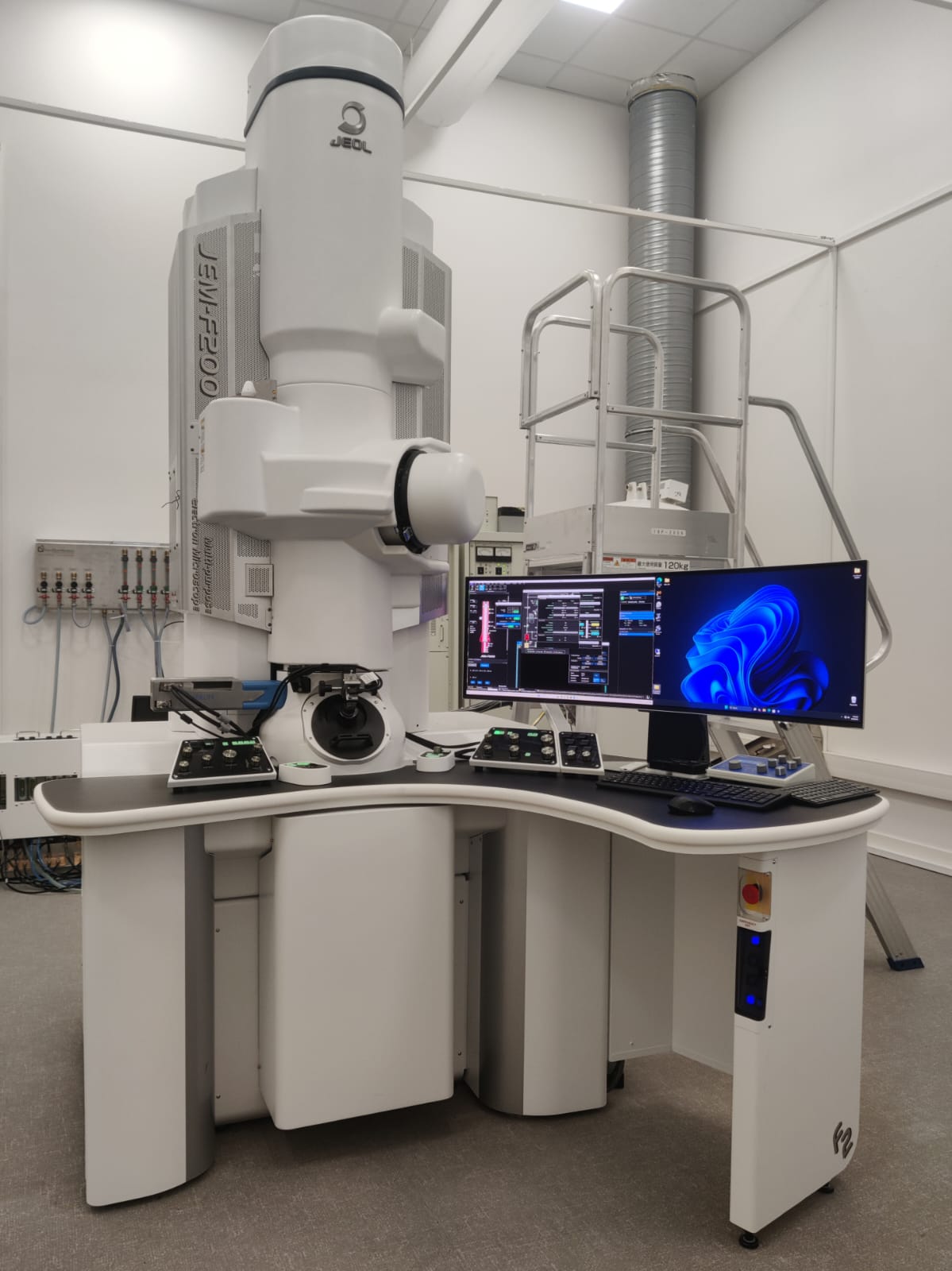

TEM JEOL JEM200
The JEOL JEM-F200 transmission electron microscope (TEM) is a versatile, state-of-the-art instrument offering a wide range of imaging capabilities in both TEM and STEM modes, as well as quantitative chemical analysis by EDX.
The instrument features a configuration particularly well suited to structural studies by electron diffraction, thanks to its ASTAR electron precession system, its three-condenser-lens illumination system, and the integration of a direct electron detector.
The microscope has been installed in the PMEL facility, in the Chevreul building, since the end of July. This equipment was acquired through the CPER CHEMACT project, funded by the Hauts-de-France Region, the MEL (European Metropolis of Lille), the French State, and the ERDF (European Regional Development Fund).
Main characteristics
- Electron source: cold field-emission gun (CFEG).
- Acceleration voltages: 60, 120, and 200 kV.
- Illumination system: a four-stage illumination system allowing independent control of the probe size and probe current, as well as the convergence angle.
- Objective lens: a high-resolution objective lens with a pole-piece gap compatible with electron tomography.
- Resolution: at 200 kV, the resolution is 0.16 nm in STEM mode and 0.23 nm in TEM mode for point-to-point imaging.
- Goniometer: the SPECPORTER specimen goniometer allows automatic insertion of the specimen holder.
- EDX detection: two retractable, windowless SDD-type EDX detectors positioned at 90° to each other, providing a total collection solid angle of approximately 1.7 sr.
- Three detectors are available for the STEM mod: HAADF and BF detector as well as segmented SAAF annular detector.
- Several cameras are available for TEM imaging and electron diffraction, including 4D-STEM experiments: Sight Sky CMOS and MerlinEM retractable direct electron detector as well as BASLER CMOS camera recording the TEM phosphor screen.
- The microscope is equipped with a NanoMEGAS DigiSTAR P2010 electron precession system, allowing the beam rotation frequency to be adjusted from 0.2 to 200 Hz.
- Three types of specimen holders are available: (i) a beryllium double-tilt analytical specimen holder; (ii) a single-tilt specimen holder equipped with two interchangeable tips: a conventional tip and a tip allowing ±70° rotation for electron tomography experiments; and (iii) a single-tilt specimen holder allowing the simultaneous loading of three specimens.